So I’ve been on some lovely Astronomy sites lately, and every post is plagued by “Flearthers” or “Flat-Earthers.” They come in to say every picture of space is fake, the Earth is flat, and they drive the signal-to-noise ratio into unusability.
One result is that when people ask honest questions, like “Isn’t the Moon always full in space?” they get a lot of push back because people think they’re Flearthers. That has to get sorted out before their question gets answered.
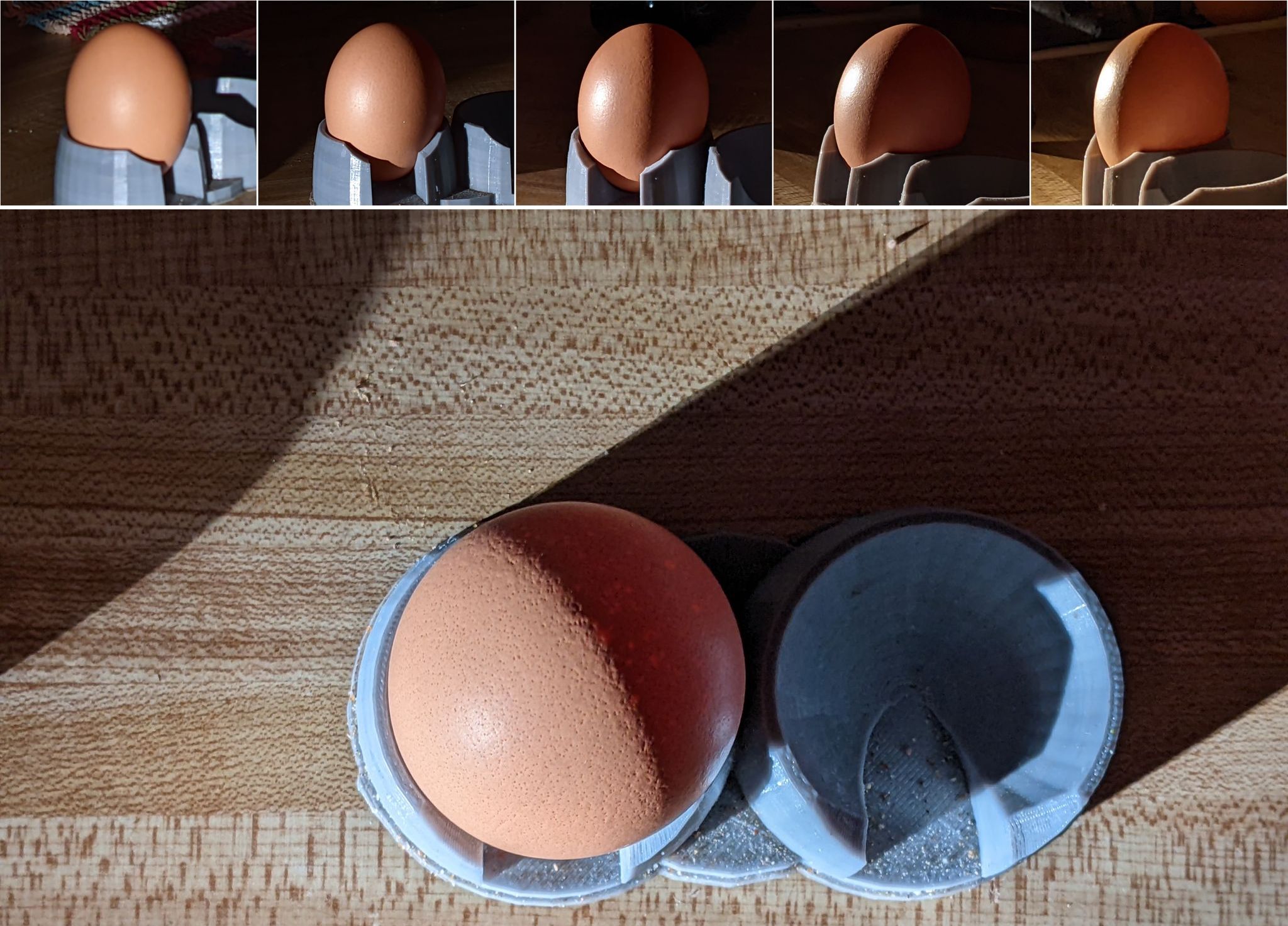
I created the following graphic that demonstrates the relationship of a (semi-) spherical object, light, and Point Of View with regard to apparent phases. It’s light on my kitchen counter falling on an egg.
The day-night terminator passes over the moon’s polar region at a right angle to the direction of light from the sun. But we view the moon at its equator, not its poles.
Apparent phase of the moon depends on our POV in relation to the moon. Since the Earth rotates at 27.~ times the moon’s orbital period, and the moon is in tidal lock with the Earth, we will see every “phase” of the moon, but only one side of it.
I didn’t rotate the egg as I took each side-photo, so it is not in tidal lock with my phone. But otherwise the principle is the same.
- Related: “Flat-Out Wrong” the Earth and rotation speed
- Once in a while, the Earth’s shadow falls on the moon. This is a “lunar eclipse,” which is a different phenomenon.

 georgewiman